What size dumpster do I need for a basement?
A 20 cubic yard dumpster in the vast majority of cases. A basement emptied of its furniture, carpet, partitions and boxes fills a dumpster quickly without weighing much: volume is deceptive. A 10-yard is enough for a single room or a cleanout; a 40-yard makes sense when the whole house is being emptied.
How many cubic yards for a roof?
A 10 or a 20-yard — and weight decides, not volume. Shingles are heavy: the included tonnage is reached well before the box is full, and the overage is billed from the weigh ticket. Count your bundles (or divide the area by 32) in the calculator on this page, or give us the number at 514 708-2424: we'll tell you which size leaves without going overweight.
What is the difference between a 10 and a 20-yard dumpster?
The height, and only the height. The 10-yard is a 20-yard filled to half its height: 14 ft by 8 in both cases, 2.5 ft high instead of 5. It takes exactly the same room on the ground — picking a 10-yard to gain length in a short driveway does not work.
How many pickup truck loads fit in a dumpster?
3 to 4 pickup-truck loads for a 10-yard, 6 to 8 for a 20-yard, 12 to 16 for a 40-yard. It is the simplest benchmark when you are weighing hauling it yourself against renting a dumpster.
How many feet does the dumpster take up on the ground?
The 10 and the 20-yard lay down the same rectangle: 14 ft long by 8 wide. The 40-yard goes to 20 ft by 8. Then add whatever the truck needs to back in and set the box down straight. Quickest way to check: a 20-yard is about the size of a Dodge Caravan.
Is mixing materials allowed?
Only in the dry materials box, where wood, drywall, metal, shingles and furniture travel together. The other four are each kept to one material and one alone — soil, rocks and sod; concrete; bricks and mortar; asphalt: slipping anything else in moves the whole load to the sorting rate. Tires and chemicals, for their part, belong in no box at all.
Can you get a 40-yard dumpster for concrete, soil or asphalt?
No. The four single-material dumpsters — soil, rocks and sod, concrete, bricks and mortar, asphalt — come in 20 cubic yards only. For a large volume of heavy material, the right answer is two 20-yard dumpsters.
What goes in no dumpster at all?
Three families: tires; paints, solvents and oils; and acids, aerosols, batteries and propane tanks. No size and no type is an exception. Those materials go to an ecocentre or a specialized drop-off point. The rest leaves without trouble, as long as it is in the right box.
How many days does the rental run?
Seven for homeowners — 15 for contractors — from the 10-yard to the 40-yard, and the term stretches by arrangement when a job falls behind. The other way round, a dumpster freed up within 48 hours of delivery earns the $50 Libération Express credit.
Why is there a scraping fee in winter?
Because a frozen load does not fall out when the box is tipped: the disposal facility brings in an excavator to break loose whatever is still stuck to the steel, and it charges for the work. Megabac Environnement passes that on exactly as received, with no markup and the weigh ticket to back it up.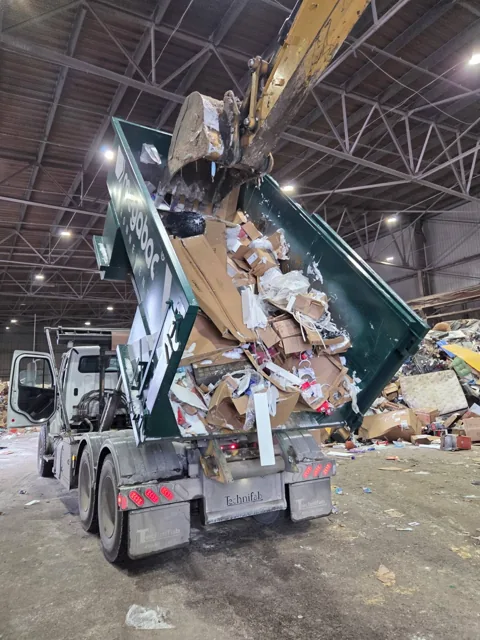 What it looks like in winter: one of our trucks at the Longueuil disposal facility. The materials froze to the walls and the excavator has to pry them off — that is the work the facility bills.
Can the dumpster damage my asphalt or my pavers?
That is the risk, and it is exactly what the PROTEC-O-SOL system prevents: planks built into the dumpster spread the load at drop-off and at pickup, without you having to supply or place anything. Our drivers' tip on top of that: lay four flattened cardboard boxes or a thin sheet of plywood where the dumpster will sit, so the steel never touches the surface directly.